Diary: Jean McGarry, New glasses
Reading Svetlana Alpers , studying Van Gogh and Vermeer, and getting new glasses
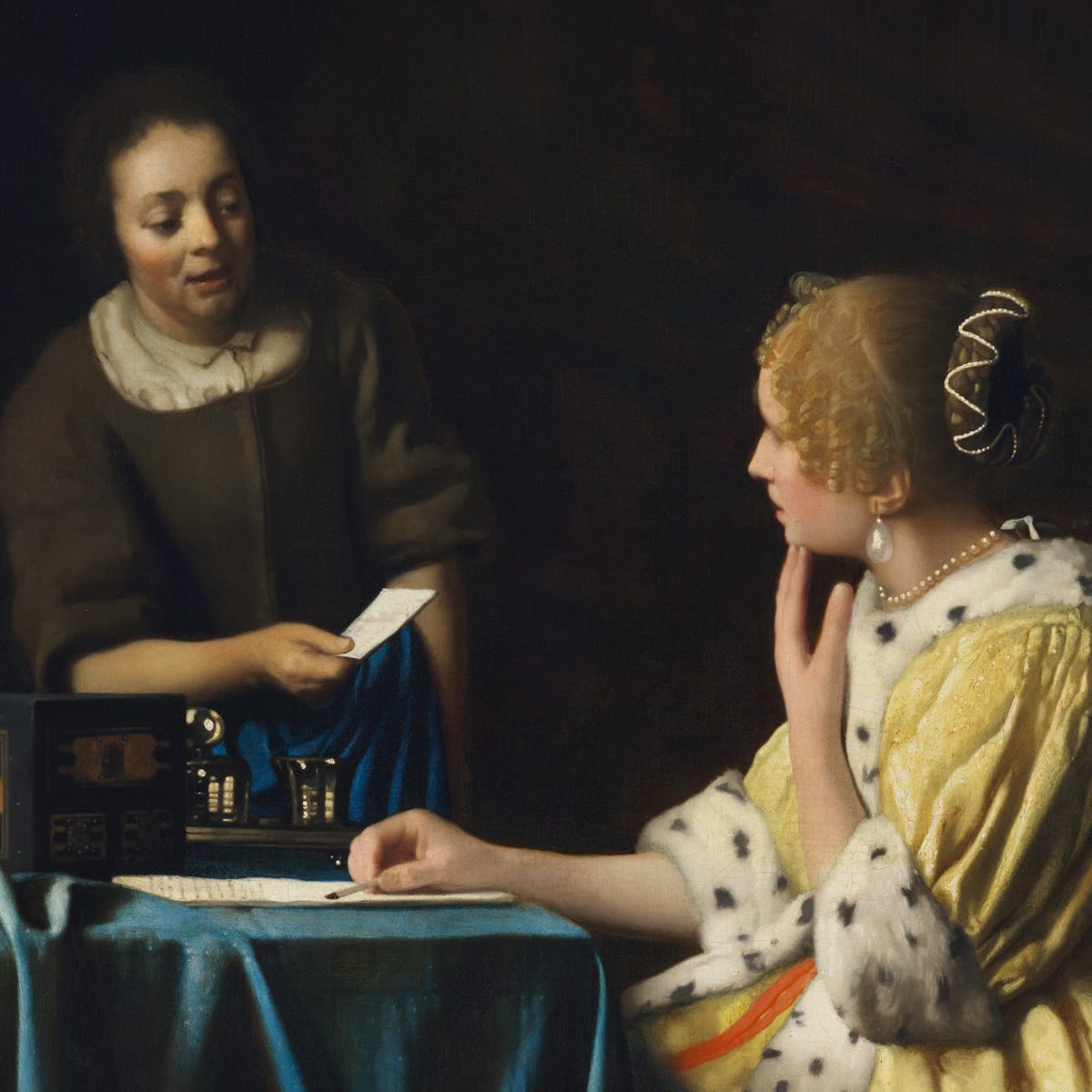
Johannes Vermeer, Mistress and Maid (The Frick Collection). The Frick Collection in New York, which has just reopened after an extensive renovation that opens its never-before-seen second floor to the public, currently has an exhibit of Vermeer’s paintings of women reading letters: the Frick’s Mistress and Maid, the Rijksmuseum’s The Love Letter, and the National Gallery of Ireland’s Woman Writing a Letter with Her Maid. The exhibition is on view until August 31. In contrast to Svetlana Alpers, they characterize the paintings depicting featuring “love letters.”
An anthropologist friend and I, who have been working for some time on the art (and writing) of Vincent Van Gogh, recently met at the National Gallery to spend a few hours gazing at the six paintings in residence there. That gaze was so lingering that we ended up sitting on camp stools before each of them, three portraits, a landscape, a bowl of roses, and a farmhouse. The longer we sat, the more we saw, but we didn’t see the same things. Not surprising, perhaps, as Van Gogh’s paintings are not (meant to be) mirror images of faces, trees, flowers. His very free treatment (in drawing and application of color) invites switching back and forth from resolution: a baby’s face, a bentwood chair, or a full-blown white rose, to the strokes, blots, and smudges that swarm over the canvas.
It’s a different matter when gazing upon the landscapes of Dutch seventeenth-century painters, which do appear as mirror-perfect reflections of lake, field, barn, and cattle. There, on the canvas, lies a semblance of the physical world, rendered in suave line and immaculate color—flattened yes, but not so different from the image that the retina projects on the back of the eye. This very limpid (slick?) transfer from sight to canvas succeeded, according to Svetlana Alpers in her magisterial The Art of Describing: Dutch Art in the Seventeenth Century, only in demoting the value of these works, along with their makers, seen as mere copyists, dim-witted and unenlightened, when compared to the sublime standard set by the Italian Renaissance and its underwriter, Georgio Vasari.
What do we see when we look, and what, if we are painters, do we find worthy of recording? Art historians’ eyes and judgment—again, according to Alpers—failed, under the spell of the “Italian bias,” demeaning a Northern art that seemed to them to depict only “portraits, still lifes, landscapes, and … pleasures taken in a world full of pleasures, pleasures in the town, the churches, the land.”
Versus the “serious” Italian art of the quattrocentro, art that honored the centrality of man and was aimed at the sightlines of the viewer, showing scenes of high drama, heroic or religious, and packing an emotional punch: an art, in short, that told a story. The problem for an iconoclast like Alpers, who wanted to break (or at least loosen) this lock that the Italian paradigm had on all painting, and to reinsert Dutch landscape and homescape into the canon, was to “make it strange,” and “to see what is special about an art with which we feel so much at home, whose pleasures seem so obvious.”

