
Diary: Laura Kolb, “Sing, Notes”
Venturing into the Iliad with new students and Emily Wilson’s notes
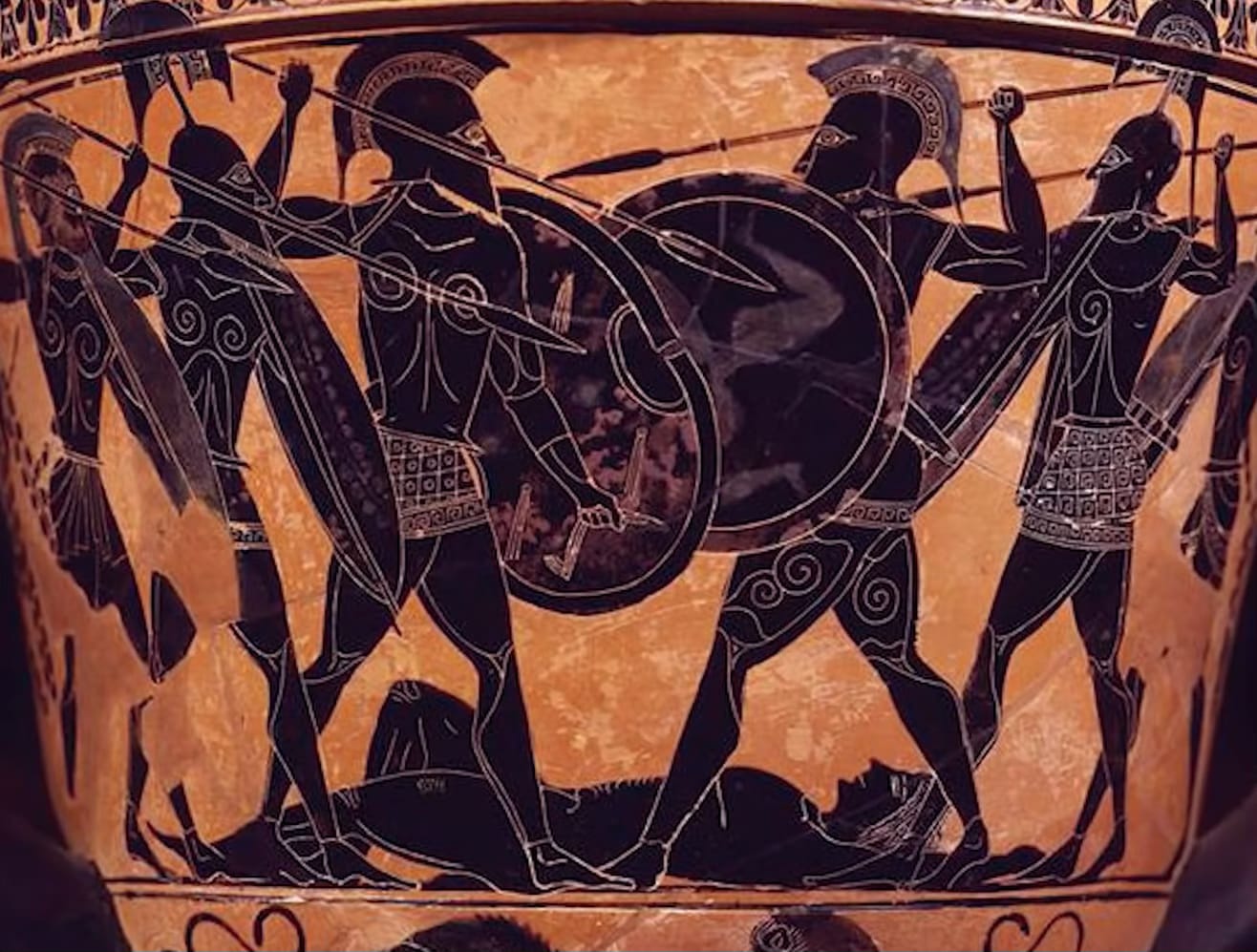
Black-figure wine-drinking bowl in the style of Exekias, depicting the fight for the body of Patroclus. Farsalos, Greece (c. 530 BCE). National Archaeological Museum, Athens. According to the Oxford University Press blog, the image depicts Ajax holding a “Boeotian” shield and Hector holding a shield with a “triskelis” blazon, a design showing three running legs

In the recently issued Norton Library version of Emily Wilson’s 2023 translation of the Iliad—a compact, low-priced book designed to tempt college instructors to assign it to students—the translator’s commentary notes take up just over a hundred pages. Densely printed, they appear at the back, between Hector’s funeral and a collection of useful genealogies. There are 1,057 of them. Book 2 has the most (eighty-six); Book 10 has the fewest (twenty-two). Compared to most modern Iliads and Wilson’s own translation of the Odyssey—where some books lack line-by-line commentary altogether—this Iliad abounds in annotation.
Wilson’s Iliad has drawn a wealth of positive criticism. I like the verse—the even-keeled pentameter tugs interestingly against the poem’s intensities—but, a non-Classicist, I am not qualified to judge the translation’s fidelity. What I am qualified to judge, having spent the Fall slowly working through the Iliad with thirty CUNY undergraduates, is the notes. They are magnificent. They exemplify what G.W. Bowersock called, in a classic essay on the annotator’s art, “that smooth and delicate blend of interpretation, supplement, and surprise that makes footnotes seem both independent and indispensable.”
Unsurprisingly, many notes gloss unfamiliar figures, customs, and objects. They bridge the cultural gap—at times, more of a chasm—separating modern readers from the poem’s ancient world. Through them we learn the names and quirks of the Olympian and lesser gods, the rules of guest-friendship, what an aegis is. The first note to the first lines—“Goddess, sing of the cataclysmic wrath / of great Achilles”—informs us that “Goddess” (represented in the original by the generic thea) likely refers to Calliope, muse of the epic form.
