
Diary: Robert Morgan, Wildacres
At home I would have been tying bean strings and hoeing corn in the hot fields. Instead, I was sitting on the porch high in the Blue Ridge Mountains talking about German philosophy
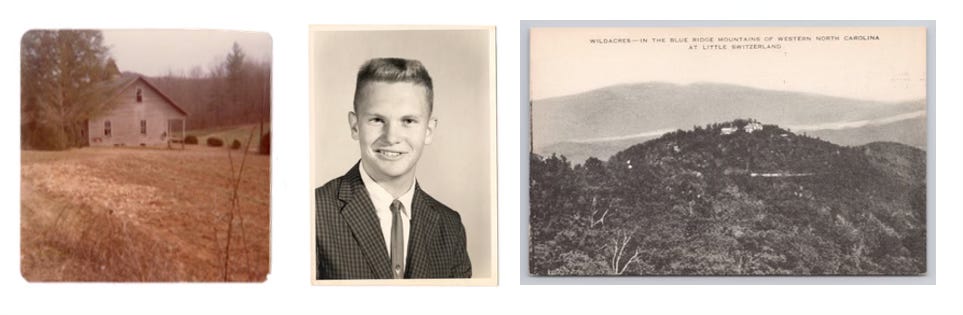
Robert Morgan’s grandfather’s farm in Green River, North Carolina; a school picture from around the time he went to Wildacres; Wildacres, on Pompey's Knob in the Blue Ridge Mountains

In the spring of 1961, a number of strange and exciting things happened to me. I applied to the early admissions program at Emory College at Oxford, Georgia and was accepted. Emory at Oxford admitted students after their junior year in high school if they had good SAT scores. I had saved enough money from bean farming and selling my cow Ginger to pay for a year of college, with the help of a small work scholarship. In September I would be leaving home for Oxford, Georgia. Emory was best known as a medical university. My vague plans were to study something having to do with science, and perhaps pursue a career in medical research.
Also, in the spring of 1961 the principal of East Henderson High School announced over the intercom that one student from the school would be selected to attend a Civitan Club camp at Wildacres, near Little Switzerland, in the mountains east of Asheville. Those interested should come to the school office to apply. Uncharacteristically I hurried to the office and submitted my name. I was in a mood to try new things but thought it unlikely I would be chosen.
Much to my surprise I was selected. Perhaps no one else applied. In any case, after school was out in early June, I found I was headed to Wildacres for a week. I’d never been away from home before. Attending the Civitan Club camp seemed good practice for going away to college in the fall. I bought a duffel bag in which to carry my things, and new chukka boots made of heavy green corduroy cloth. I was a little scared, but mostly I was curious.
The Civitan Clubs in those days supported a number of charitable activities. Their mission at that time was to improve human relations, and the stated goal of the camp, in the literature sent to me, was to study human relations and the issues of equality, citizenship, and civil rights in the context of contemporary society. The conference at Wildacres would consist of counselors and teachers, and about a hundred campers. Classes would be offered in history, especially Southern history, race relations, music, modern dance, literature, folklore, and nature study. Recreational activities would include hiking on mountain trails. In the evenings there would be lectures and concerts.
The trip to Wildacres in early June was going to be an adventure for all my family. Daddy would drive us in the green Studebaker pickup, and Mama would pack a picnic lunch to eat on the way. My sister Evangeline went along also. We left on Sunday morning, all of us packed into the cab of the truck, my duffel bag in the back. I’d never been east of Asheville before, and the trip was exhilarating; we passed through Oteen and Swannanoa, then Black Mountain, and descended out of the mountains on Highway 70 through one curve after another to Old Fort at the edge of the Piedmont. I kept thinking of Thomas Wolfe’s description of making the same journey by train in Of Time and the River. Wolfe’s rhetoric soared in my head. I too had a feeling of release, of escaping over the wall of the Blue Ridge Mountains into the wider spaces of the foothills, through the little towns with water tanks, furniture factories, the wide river bottoms.
The climb back into the mountains toward Little Switzerland and the Blue Ridge Parkway was impressive. Mountain rose above mountain. We drove higher and higher, then turned off onto a smaller highway, and on top of the ridge found the driveway to Wildacres. The brochure had said we should arrive by four o’clock. It was only a little after two. I was glad to be coming early, before others, for I was a little ashamed to be arriving in a pickup truck. As it turned out, only two counselors were there ahead of me. I unloaded my duffel bag and said goodbye to Mama and Daddy and Evangeline. As they drove away and disappeared down the winding driveway, I felt I’d crossed a threshold into a new phase of my life.
The campus seemed on top of the world. There were benches around a fire pit for bonfire gatherings. Through the trees I could see the deep valleys below on either side. After scouting out the place, I sat on the porch watching others arrive in limousines and convertibles, on buses from Marion. I struck up conversations with new arrivals from Charlotte, Raleigh, Greensboro, Chapel Hill, Durham. It was clear that the other participants were from more affluent backgrounds than me and were more socially sophisticated. Then a couple from Chicago arrived, Mr. and Mrs. James Dodman Nobel. They were the senior counselors and instructors. She was a modern dancer, and he was a poet. They sought me out immediately and took me aside to ask if I would lead in prayer before supper that evening. They also asked if I would play the piano while Mrs. Nobel danced, and Mr. Nobel read his poems. I was so surprised I hesitated, and then agreed to both requests. I was not used to being singled out that way. The Nobels had read the “statement of interests” included in my application. Apparently, I was the only camper who claimed to compose music, write stories, and play a role in a local Sunday School. I was flattered and a little dazed.
That evening I did indeed say grace before supper in the big dining room, and I did improvise on the piano at the evening program while Mrs. Nobel danced, and Mr. Nobel read poems to the assembly. It seemed odd that I was asked to do these things while surrounded by many who were probably better qualified to lead in prayer and play the piano. Mrs. Nobel’s dancing was a surprise and a discovery for me. I knew little about dance, formal, modern, or otherwise. I’d been taught that dancing was a sin and had never even taken part in a square dance. Mrs. Nobel wore black leotards and moved in irregular and unpredictable ways, with little repetition. She rolled on the floor and tied herself in knots, ran forward and back, dropped in a heap, spread her arms, circled, backtracked, plunged sideways, and turned like the hands of a clock. It was all spontaneous and fascinating. I saw there was no way to go wrong at the piano, for her moves were independent of the music.
Mr. Nobel’s poetry was in free verse, not unlike the poetry of Sandburg or Walt Whitman. Only later would I realize how deeply influenced Mr. Nobel’s poetry was by the Eliot of “The Hollow Men” and “Gerontion.” He had a little book of poems with handsome woodcuts, called Modern Trilogy. One of his phrases that stuck in my mind was “implicitly immortal.” He also used the word “hecatomb,” which I’d never heard before. In the 1930s the Nobels had become involved with an arts collective in Chicago called Park House where she danced and taught dance. He offered classes in politics and poetry, and also taught at a junior college. They had been political activists, involved in civil rights and union organizing. I’d never met anyone with so much energy and elan.
The counselor in charge of our dormitory was a recent graduate of Pfeiffer College who had majored in philosophy and theater. I engaged in several conversations with him about Nietzsche and Schopenhauer and George Bernard Shaw, one of my favorites at the time. Most of what I knew about German philosophy was from encyclopedias, though I had read selections from Thus Spake Zarathustra and The Birth of Tragedy from the Spirit of Music. I didn’t even know how to pronounce Nietzsche’s name, calling him “Nitch,” and was corrected by the counselor. I had also read Colin Wilson’s The Outsider and was anxious to talk about existentialism and Camus and Sartre. At home I would have been tying bean strings and hoeing corn in the hot fields. Instead, I was sitting on the porch high in the Blue Ridge Mountains talking about German philosophy and drama.
