
Notebook: Where the Readers Are
A generation resists isolation and alienation through books
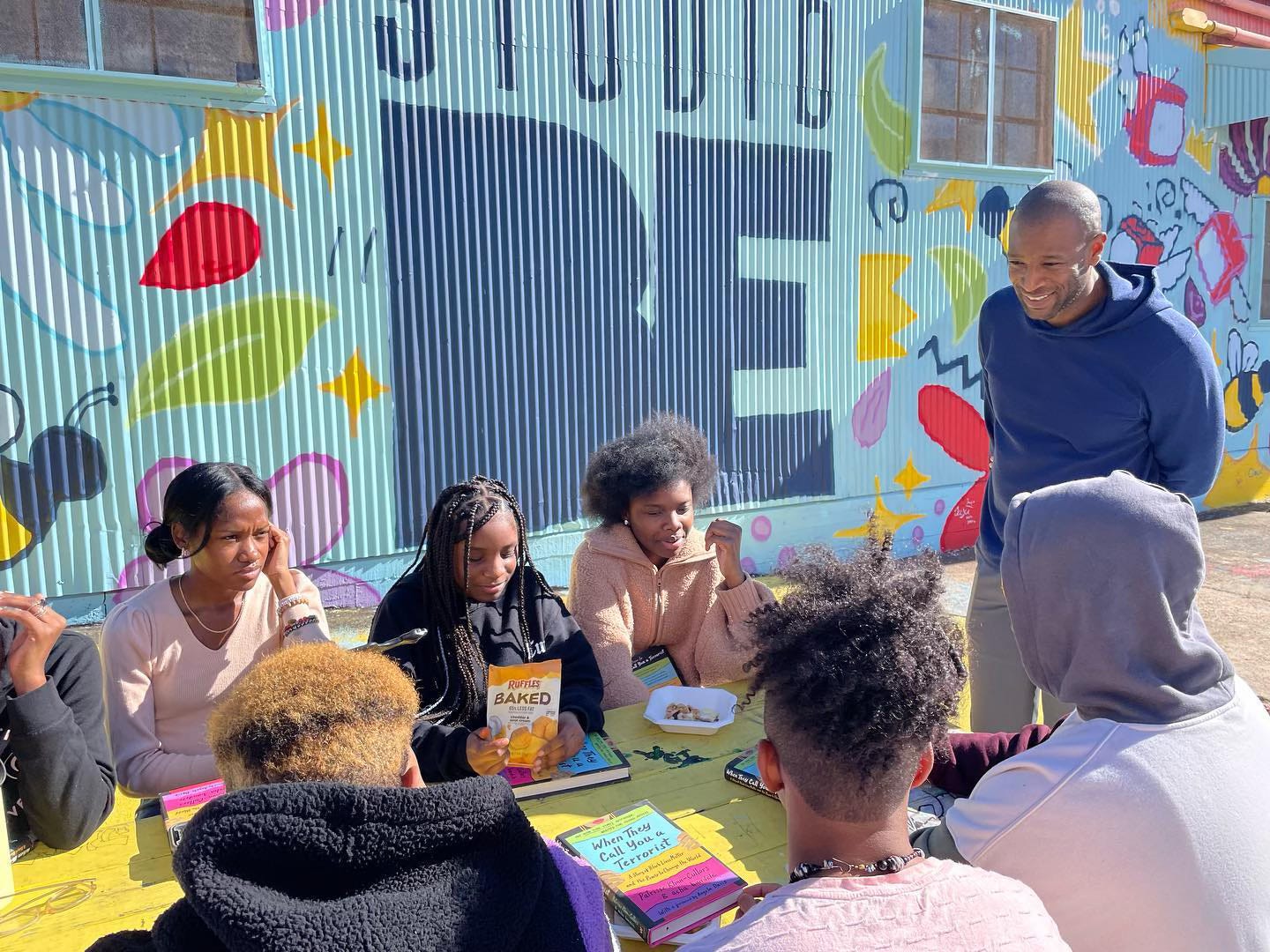
DJ Johnson, the founder of our current bookselling partner Baldwin & Co, joins a reading group with young artists from the Eternal Seeds project in New Orleans

Amidst the funereal gloom about the state of reading in America (students don’t read books, leaders scorn learning, literacy is giving way to orality), there have recently been some counterintuitive reports of hard-nosed business types detecting a market out there among readers. A few months ago Shein, a “fast fashion” and lifestyle shopping concern based in Singapore, announced a bookselling partnership with the used-book outfit Alibris. The collaboration was reportedly “driven by growing demand from its community,” mostly young women, “among whom analog media is making a comeback.” They cited an internal survey of over 11,000 US adults, one third of whom said they read books daily or weekly. A Bain & Company annual Media Consumption Survey released last fall found that 60 percent of US consumers would like to read more books and a similar percentage “devote their full attention to reading” when they do, with respondents seeking the authenticity of “a flesh-and-blood writer.” Bain argued that the data suggest “people are looking to try to break their obsession with digital media,” urging the publishing industry to capitalize on a “real grassroots momentum right now” for getting off screens. A 2021 Pew study found that people then aged eighteen to twenty-nine had the highest rate of reading of any US generation, with almost 70 percent preferring print. And a 2023 American Library Association survey found that they use the library more than any other age cohort.
Accordingly, the production studio A24, as part of an expansion that included opening an in-person theater in Greenwich Village featuring screenings and series curated by Jodi Foster, Spike Lee, and Sofia Coppola, recently announced a partnership with Barnes and Noble that would bring events and merchandise to kiosks in bookstore locations around the country. In December book-club doyenne Reese Witherspoon launched a “Gen-Z focused” book club under the auspices of her “media and lifestyle brand” Hello Sunshine. Hello Sunshine’s research showed that “reading is now one of the top five leisure activities among Gen Z women, with 74 percent reporting they regularly read books.” “VP of Brand” Mukta Chowdhary said, “What we’re seeing—and what our research made clear to us—is that Gen Z women are hungry for community,” and that “reading is now one of [their] top five leisure activities,” with more than one in three saying they “find community through book clubs.” The program’s intended audience is “one that blurs the line between readers and lifestyle consumers,” aiming “to engage its members at the ‘cross-section’ of their interests through partnerships like the one with Coach—which at a recent Sunnie event hosted a ‘Book Nook’ featuring some of the company’s handbags.” In other words, growing readers out of non-readers. In a 2024 New York Times profile of Reese Witherspoon, the first author featured in her original book club, founded in 2017 for women somewhat older than “young,” said “when I was on book tour, a lot of women would tell me, ‘I haven’t read a book in four years, but I trust Reese.’” Four years later, on tour for her second novel, she “met women who were reading a hundred books a year.”
Curious about Book Post Notebooks, on books, writing, publishing and ideas? Find a Reader’s Guide here
I remembered a couple of stories in Vogue in recent years about how books have been popping up in television shows (did anyone else notice Shiv Roy reading Sally Rooney at the beach?) and fashion compaigns aspiring to “tap consumers’ heightened interest in the act of reading.” A London bookseller “known for supplying literature to industry insiders” told Vogue Business, “when a fashion brand aligns with literature, they are making an allusion to quality and permanence.” A “strategic foresight consultant” told Vogue Business, “Literature is a tipping point for reimagining traditional stores as cultural hotspots and will help luxury brands connect with Gen Z high-net-worth individuals who value creativity and community.” (A fashion scholar at Parsons hilariously added, “The literary world still has a more authentic cultural cachet insofar that it is less connected exclusively to a market.”) Here they invoke the notion cherished by independent booksellers of the “third place” where people gather and forge connection (home and work being the first two): “Faced with a decline in footfall to bricks-and-mortar stores and a hybrid work culture that has left consumers eager to leave the house, brands are transforming retail storefronts into third-space hubs for community, culture, and creativity.” In 2023 the designer Rachel Comey created a line of dresses in collaboration with The New York Review of Books, a milieu not often in my experience identified as chic. (Vivian Gornick made stylish reference to Lewis Mumford at the party.)
In another indicator, 2024 saw an efflorescence of new book clubs begun by younger celebrities like Dua Lipa, Emma Roberts, Emma Watson, Sarah Michelle Gellar, Florence Welch, and Dakota Jackson, generally leaning toward literary fiction, apparently because they all genuinely like the books and want to read in company. Actress Emma Roberts, co-founder of Belletrist, complained “When I'm reading a book on set, some people will come up to me and ask, ‘You read?’ And I say: ‘What part of that is surprising?’” Emily Gould had a characteristically cheeky survey of the phenomenon under the title “Why Does Every Famous Woman Have a Book Club Now?,” anointing Kendall Jenner “the queen of being photographed with books that both are good and also coordinate with her swimwear” and crediting Kendall Jenner’s “book concierge,” poet Ashleah Gonzales, who has her own Instagram-based book recommendation gig, for the excellence of Kendall’s taste. Though these endeavors are mostly housed in a now-ancient repository of book trends, Instagram, they nod toward the power of social-media juggernaut TikTok in fueling the contemporary book business, particularly the popular genres of romance and romantasy, which adapt well to the emotive environment of the the TikTok video and are read widely by younger women and are pretty much (along with religious books) holding up the book business. (Publishing observer Jane Friedman quoted a half-baked theory of mine a few weeks ago that perhaps some of the yen for romantasy is a late manifestation of the reading enthusiasm of the Harry Potter generation, who from 1997 to 2007 received such a gusher of early, fantasy-inflected reading delight at a sensitive age, in a very communal, pan-cultural form.)
There have also been a number of articles recently about the growing popularity of in-person book clubs among younger people, mostly women, seeking social connection. (Can it be a surprise that they favor books about finding love?) In a piece on young women and book clubs NBC reported that event platform Eventbrite found a 31 percent rise in book club events between 2023 and 2024. Zoe Epstein, of the book club platform bookclubs.com, told book critic Ron Charles in 2023 that 25- to 44-year-olds make up more than 40 percent of those who have joined the platform since its founding in 2018. Enthusiasts reference a yearning for human companionship after the pandemic, the alienations of digital life, and the isolation of remote work. “It’s easier to put down the phone when everyone else around you is doing it, too,” said one habitue. Molly Young wrote in 2023 in The New York Times about a weekly gathering of people who read quietly together in public that had gone viral on TikTok; by last November Pop Sugar declared there to be nearly a thousand official such “silent book clubs.” Amidst trends showing younger people suffer from more social anxiety, silent book clubs offer a hospitable environment for introverts, “people who don’t really want to socialize but want to be social,” allowing them to be in company and alone, sparing them the pressure of pronouncing on the books.
In a January podcast, Terry Finley, the CEO of the bookstore chain Books-a-Million, most of whose customers are concentrated outside major coastal metropolises, particularly in the south, said their “core demographic” had changed from a “forty-five-year-old woman, married with two children” to women between eighteen and forty, a very different customer. Similarly the influence of the once-preponderant troika of celebrity book clubbers, Oprah and Jenna and Reese, who once catered to that audience, has begun to wane. (One of Reese Witherspoon’s collaborators told the Times interviewer that they schedule lighter books for December and May—busy months for mothers.) In a 2024 expose for Esquire of how the mighty three made their selections, former Random House social media manager Sophie Vershbow wrote that mixing the scene up with younger and more eclectic tastemakers would be a good thing. (“The male celebrity-book-club market is practically untapped,” she noted.) Terry Finley said the interests of these newer readers are “a mile wide and an inch deep … things that are driving them, the BookTok titles, the romantasy, fiction more broadly, it’s not one author, it’s not one lane.” They are curious and coming into the stores ready to find something new, not like the traditional customer who was driven to a few “tent-pole” bestsellers. (He mentioned that horror seems to be taking over for romantasy. Also perhaps no surprise.) All these avenues for finding reading testify to the age-old marketing power of the personal recommendation, which has a new salience when so much of the information we receive is driven by invisible computation. The “influencer” both is and is not a creature of the algorithm.
There are also signs that these younger readers are opening up traditional publishing’s weddedness to the expensive new hardcover, which for generations has floated the publishing industry and trained marketing budgets and big advances on the interests of well-heeled readers. (Barnes and Noble CEO James Daunt has said that he believes the “lifecycle of hardcovers in the United States is a big problem and needs to be rethought.”) BookTok has made sensations out of books that are years old; Open Road, whose business is helping publishers promote their older books, had a record year; and influential book substacker Naomi Kanakia recently reminded New York literary people that there are actually many great books already in existence, being read by many satisfied readers, and selling many new ones to a narrow band of cognoscenti isn’t necessarily the be-all-and-end-all.
That our phones are not our friends, and we should be training our minds on less malevolent inputs, seems to be an accelerating realization as artificial intelligence invisibly works its gangrenous way through digital language. Jonathan Haidt’s 2024 argument that social media has had truly baleful effects on children seems to be receiving more widespread acceptance, even among the tech-friendly; more and more schools are successfully removing cell phones and Meta is facing what could be the first of many lawsuits against tech companies for harms to children; tech’s baleful effects on adults, Jonathan Haidt told the podcast Hard Fork in January, may also be plainly visible but harder to legislate. A movement away from it seems abroad in the land. I feel I see more books on the subway than I did even a month ago. One of America’s many young-woman book-group organizers told NBC news, “Books are political, in a sense, and there are so many things within books that help us to really navigate the world that we are currently living in, whether that’s like a fantasy novel or a thriller. [Book clubs] open up this idea that we can now all sit together and talk about this book and enjoy this moment together, while also then allowing ourselves to go forth into the world feeling like we’ve learned something.” What other communities could be mobilized with an appeal to their curiosity and their need for connection? Publishing Substacker and Big Five editor Sean deLone says that “of all people, Joe Rogan remains the most surefire podcast to deliver book sales.”
The alchemical combination of internality and collectivity that a book—or any deliberate work of culture—offers is beckoning to us, a country teeming with alienated people isolated by the devices that bind us even as they distract us from the liberations of solitude—if we can only hear its call.
Learn about our the book club of our partner bookstore, New Orleans’s Baldwin & Co, here. “Companionship and intellectual stimulation—and thinking quickly during book club discussions—all of these things have been proven to be very healthy … If you’re looking to meet others cool people in New Orleans who share similar interests to you, then joining our book club will be a great way to do that. For book lovers, there are few things that forge a bond as instantly as meeting someone else who loves books.”
Ann Kjellberg is the founding editor of Book Post. Read her Notebooks on books and the reading life here (Reader’s Guide here).
Book Post is a by-subscription book review delivery service, bringing snack-sized book reviews by distinguished and engaging writers direct to our paying subscribers’ in-boxes, as well as free posts like this one from time to time to those who follow us. We aspire to grow a shared reading life in a divided world. Our paying subscribers support our work and receive our straight-to-you book posts. Some Book Post writers: Adrian Nicole LeBlanc, Jamaica Kincaid, Lawrence Jackson, John Banville, Marina Warner, Álvaro Enrigue, Nicholson Baker, Kim Ghattis, Michael Robbins, more.
Baldwin & Co, in New Orleans, is Book Post’s Winter 2025–26 bookselling partner! We partner with independent booksellers to link to their books, support their work, and bring you news of local book life across the land. We send a free three-month subscription to any reader who spends more than $100 at our partner bookstore during our partnership. To claim your subscription send your receipt to info@bookpostusa.com. And support the Baldwin & Co nonprofit’s mission of leveraging the power of books to ignite social justice and inspire change with your donation or membership—or see if there are ways to support your local bookseller financially. Read more about Baldwin & Co here.
Follow us: Instagram, Facebook, TikTok, Notes, Bluesky, Threads @bookpostusa
Formidable roundup/analysis of an encouraging trend, Ann. Thank you. I went recently to a silent-reading meetup organized by a local alumni group; I was the oldest person there by decades—and the only person who'd brought a nonfiction book. Probably because I have spent so much of my reading time alone (even if I'm in, say, a coffee shop or library), I found it a little distracting to be surrounded by a bunch of other people gathered to do the same thing. Almost like being in elementary school again. But it was good to see no phones out (just a Kindle or two). Perhaps Gen Z looks for a communal feeling in reading than Gen X/Gen Jones does not, at least not in the same way.
Thanks for this ray of hope, Ann! I can’t help wondering whether recent book banning efforts have piqued interest in reading books.