Review: (2) Àlvaro Enrigue on Cristina Rivera Garza
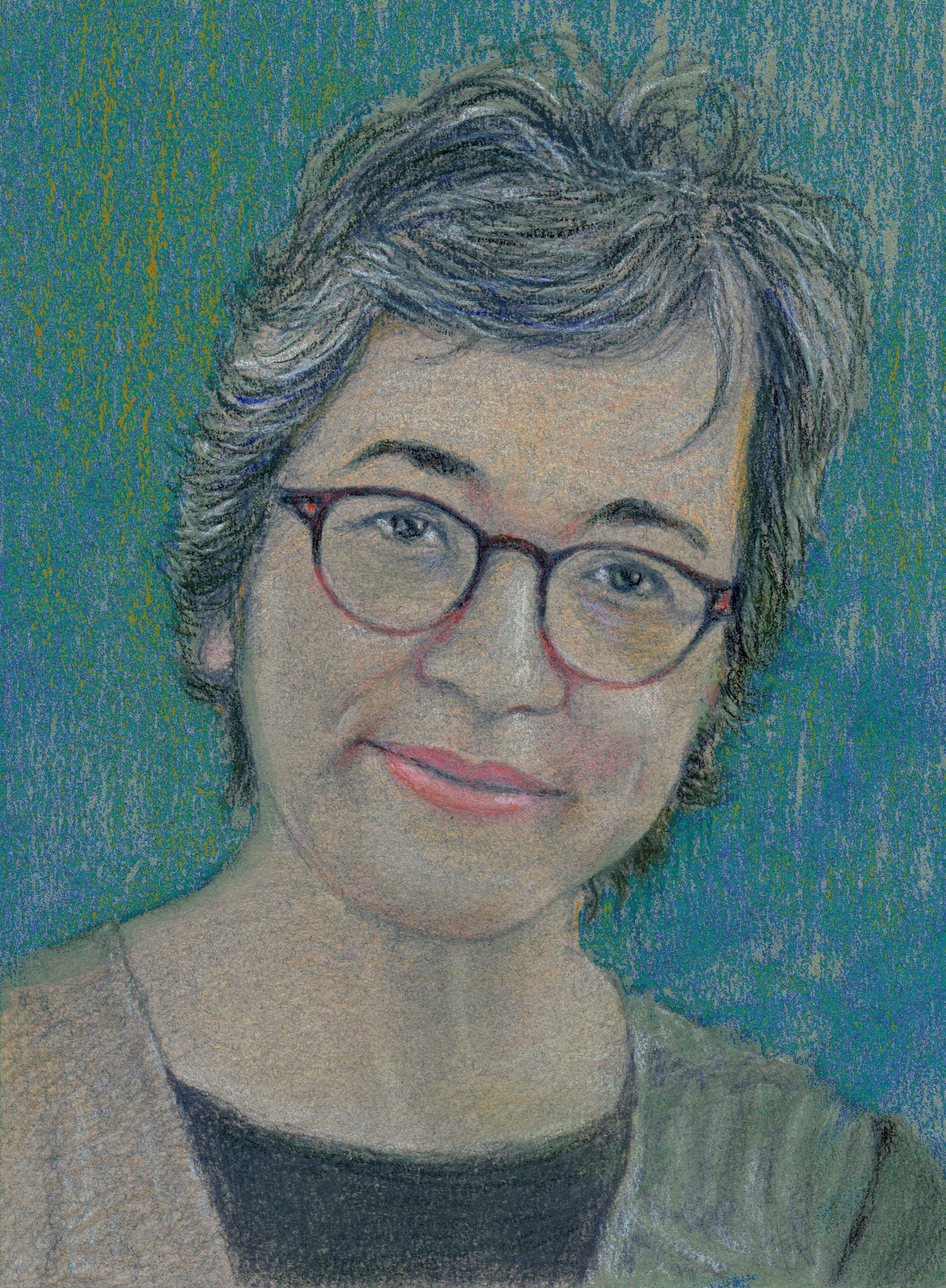
Drawing of Cristina Maria Garza by Nicholson Baker, from a photograph by Leigh Thelmadatter.
Read Part One of this post here!
Since Rivera Garza’s second novel, her characters have tended to be, or to encounter, writers who took the literary language of their period to a limit. In The Iliac Crest (published in Spanish in 2002 and in English in 2017), a woman says that her name is Amparo Dávila, the midcentury gothic Mexican writer, whom she is not. La muerte me da (2007)—untranslated—is a thriller and a study on the figure of the suicidal Argentinian poet Alejandra Pizarnik. José Revueltas zig-zags through La autobiografía del algodón, and a well-researched, but fictionally quite plausible Juan Rulfo, the ur-modernist Mexican writer—whose Pedro Páramo is the more influential and worst translated novel of twentieth-century Latin American writing—is the central character of Había mucha neblina o humo o no se qué, from 2016. (Yes it’s an horrid translation, that I suppose Susan Sontag didn’t read, or just let go, or needed the money; there is a new one, equally bad. Maybe is just that Pedro Páramo –and it’s perfectly possible that Sontag was aware of this--, as the Soledades of Góngora or Rubén Darío’s poetry, its beyond the competence limit of translation. Many times I think that it also happens with Hamlet –none has get even close to convey it’s grandeur in Spanish. Cormac McCarthy made a beautiful lyrical meditation on that in the second novel of the border trilogy. When Peter Pharm –or something like that, I’m really far away from my bookcases—following the she-wolf gets into deep Mexico, he can’t understand anything and none can understand him anymore; he is called Pedro Páramo by the doctor who saves his life. But let’s keep this meditation to ourselves: translators are heroes, and I should avoid setting limits to their work.)
What Dávila, Pizarnik, Revueltas, and Rulfo have in common is that they were considered cryptic before their books educated their readership in the ways they envisioned renewing literary writing. Rulfo eventually reached universal recognition, but Dávila and Revueltas may still reside among cult writers; Pizarnik died young, before learning that she would be the signal Argentine poet of her generation.
In 2022 Dorothy, a Publishing Project, brought out in English an anthology of short stories by Rivera Garza. The volume elegantly provides a visit to the author’s writing laboratory; it has the hygienic title New and Selected Stories, cast in white-over-blue Franklin Gothic Book font—notoriously clean—and is organized chronologically, as if to delimit the evolution of an idea of fiction.
The New and Selected Stories show how Rivera Garza has strained to make visible the machinery of suppression of individual liberty and desire in a world ruled by violence and greed. Her characters struggle to liberate themselves from the pressure of social convention, and their struggle correlates with the author’s effort to find meaningful new forms of storytelling amidst the muzzling expectations of an authoritarian tradition unwelcoming to women. Rivera Garza has been testing the boundaries of literary language for many years, and her stories have become consistently more intelligent as a result—and often sardonically fun. This volume is both a literary collection and the logbook of a process of anticolonial resistance.
It begins with pieces like “Unknowing” (from La Guerra no importa, 1991), a short story with traditional characterization and narrative, whose innovation comes from its political forthrightness: it’s a story with an embedded feminist manifesto. As the volume progresses the pieces become more densely experimental and challenge the limits of storytelling. In, for example, the story “Strange is the Bird that Can Cross the River Pripyat,” poetic language is infused with the imaginary of postapocalyptic video games. Three unnamed characters must leave an abandoned building to take a boat. Their story is notated with the cryptic programming language of the electronic music—“Intro-percussions—(eq+bass)—piano chords Kontakt (delay)—piano melody Kontakt (filter band pass) synthetized chords from the Vst 1 A1 Waldorf”—that the main character, a tough female survivor of an undefined conflict, is listening to in her headphones. In “Autoethnography with the Other,” a story that meditates on the hypocrisy of the treatment of migrants in the United States, a female anthropologist living in town of only women, discovers one night a male from some undefined “outskirts” lying hungry and weak in her yard. She hides him and they slowly form a sexual bond that liberates her from her pristine Protestant values. The narrative is punctuated with notes dramatizing the ways anthropology—a terminally colonial science—rationalizes unethical relations with others as subjects of study. In the end the neighbors rat out the narrator, the man is removed to receive an undefined punishment, and the woman reverts to her respectable suburban life. In “Offside,” a young woman arrives in a village submerged in snow and is unable to put gas in her car because she doesn’t speak the local language. A man in a restaurant can communicate with her and offers a room in his house to wait for the snow to clear. The next day her car disappears, so she stays, makes a family with the man. When the snow finally melts away, she has lived for years the mute life of a servant, and she learns that the car was always right there, under the snow.
For Rivera Garza language presents a political problem and literature a way of clearing it. A novel or a short story may not be able to change the world, but it can provide the words to think about it in new, less prejudiced ways. Catharsis, literature’s gift, can make the change permanent.
For Rivera Garza, novels and short stories are more utile than dolce, they have a use, a way of making an effective dent in reality. The bodies and memories of those suppressed—physically or politically—are gone and nothing can bring them back, but if their voices are recovered through fiction and responsible documentation, their disappearance is, at least, meaningful for others—and writing fiction is all about producing meaning where it was not.
Àlvaro Enrigue is the author of five novels, three books of short stories, and one of literary criticism in Spanish; among these his novels Sudden Death and Hypothermia are available in English and You Dreamed of Empire and Perpendicular Lives will appear in English in January. He was born in Mexico and lives in New York City.
Nicholson Baker’s most recent book is Finding a Likeness: How I Got Somewhat Better at Art. See his drawings for Book Post at the tag “N Baker Drawing.”
Book Post’s Summer Reading of Middlemarch with Mona Simpson is underway! If you are not receiving weekly installments, check your account settings to make sure you on the list, and join us in the comments! For this Sunday (July 23) we are finishing Book Two (through Chapter 22). Still time to catch up!
Book Post is a by-subscription book review service, bringing snack-sized book reviews by distinguished and engaging writers direct to your in-box, as well as free posts from time to time to those who follow us. Thank you for your subscription! Your payment supports our writers and our effort to build a common reading culture across a fractured media landscape. Please help us to grow our audience by giving Book Post to a friend, sharing this post, or cheering us on social media.
Rehoboth Beach indie Browseabout Books is Book Post’s Summer 2023 partner bookseller! We partner with independent bookstores to link to their books, support their work, and bring you news of local book life across the land. We’ll send a free three-month subscription to any reader who spends more than $100 with our partner bookstore during our partnership. Send your receipt to info@bookpostusa.com. Read more about Browseabout’s story in here in Book Post.
Follow us: Instagram, Facebook, Twitter. Special Middlemarch posts on TikTok!
If you liked this piece, please share and tell the author with a “like.”


