Review: Joy Williams on Richard Powers’ “The Overstory”
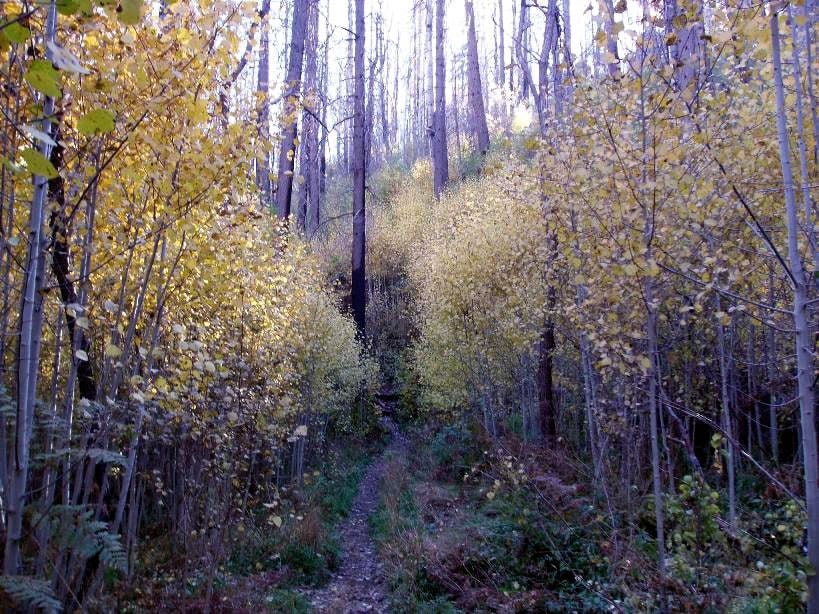
Aspens, which can regenerate from root sprouts, replacing a forest of mixed conifers after a 2003 fire. Photo by Charlie McDonald for the USDA Forest Service
I have thought for some time now that the novel has to address something other, become something other, or it will die. Though die is the wrong word. Great forests die, rare ecosystems, coral reefs, species other than our own … snip, snuff, shoot, starve, eradicate, extinguish. We die too, of course, but in a more individual fashion—in moderation, actually, under the circumstances.
What the novel will do, rather, is become absolutely irrelevant to our situation, which is dire, dispiriting, and more than likely unsalvageable and uncorrectable.
The novel concerns itself with our human drama—it always has. The intrigues, the misunderstandings, the passions and illusions. The novel busies itself with the horrors and duplicities of family life, relationships (surely one of the greatest of soul-sucking words …), war (usually its ghastly aftermath), babies (the novel depends rather over-much on babies and their impending arrival), and crime, the more gruesome and diabolical the better. The immigrant tale is a staple of the novel, as is the generational saga. Incarceration (becoming quite popular), the heartbreak of addiction, the tragedies and injustices of history, the injustices and tragedies of the so-called present—all themes of human interest or momentary attention.
Seldom does the novel trouble itself any more with the crisis of faith, the loss of faith, the weirdness of faith, whatever. But it is still very much interested in love. Love! Humans searching for it, finding it, keeping it, etc. So it’s love, sex, power, passion, war, family, love—that’s the gruel that keeps the novel limping along as it feeds us stories about ourselves. It’s all become so … tiresome.
But to suggest that human beings aren’t the most important or interesting items around is to invite censure. The novel must be forgiving of human foibles, certainly never judgmental. To be judgmental would be anti-humanist. To be anti-humanist is to be unacceptably dissonant, a crank. In the middle of William Gass’s ecstatically anti-humanist and under-valued novel, The Tunnel, glistening like a turd in a toilet, is this perception:
This is how the world looks. The world looks … trashed.
Which is very much the case. And should we not be affrighted and enraged by this every day and strive to un-trash it? And should not the novel—slumbering giantess that she is—awake and guide us by increasingly wily stratagems and effects and old-fashioned illuminations and impassioned rhetoric to perceive the magnificence and complexity of the non-human world?
Of course it should. It must. But it hardly ever does. The Overstory is an exception. The central players in Richard Powers’ latest novel are trees. It is their drama we become witness to on the page—the lives they inhabit, their intelligence, the ways they speak to us and each other, the increasingly dreadful fates they experience as a community. The Overstory concerns itself with their destruction, their slaughter, in our country, in our time. America once had numerous great, distinctive forests including the giant redwood groves of the Northwest, home to many of the largest species of trees on earth. No more than 5 percent of these original old-growth forests remain (the number is probably closer to 2 percent) their complex worlds slaughtered, never to regenerate, their deep and living soils sterilized to accommodate only a monoculture of harvestable timber.
Knowing this, knowing in a deep transformative way, will shape Richard Powers as a novelist, just as The Overstory should shape the future of the novel, moving it from its comfy and well-worn anthropocentrism into the more disturbing and demanding narratives of the elegantly structured and complex otherness surrounding us, the myriad world of being that we have … trashed.
In an interview in Conjunctions, Powers said that the heart of The Overstory is:
a rejection of human exceptionalism—the idea that we are the only things on earth with agency, purpose, memory, flexible response to change, or community. Research has shown in countless marvelous ways that trees have all of these. Tree consciousness—which we’ll need to recover in order to come back home to this planet and stop treating it like a bus station bathroom—means understanding that trees, both singly and collectively, are central characters in our own stories.
There is a thrill in reading this profoundly affecting book that is affecting in a different way. “All the ways you imagine us—bewitched mangroves up on stilts, a nutmeg’s inverted spade, gnarled baja elephant trunks, the straight-up missile of a sal—are all amputations. Your kind never sees us whole. You miss the half of it, and more. There’s always as much belowground as above.”
A family plants a tree when each of their children is born:
Each child’s tree has its own excellence: the ash’s diamond-shaped bark, the walnut’s long compound leaves, the maple’s shower of helicopters, the vase-like spread of the elm, the ironwood’s fluted muscle.
Powers’ way of looking is intense, particular, almost visionary in its attention to the beauty, the conscious presence of these brainless stationary beings.
They drive through a land once covered in dark beech forest. “Best tree you could ever want to see,” the father says. Strong and wide but full of grace, flaring out nobly at the base, into its own plinth. Generous with nuts that feed all comers. Its smooth white-grey trunk more like stone than wood. The parchment-colored leaves riding out the winter—marcescent, he tells her—shining out against the neighboring bare hardwoods. Elegant with sturdy boughs so much like human arms, lifting upward at the tips like hands proffering. Hazy and pale in spring, but in autumn its flat, wide sprays bathe the air in gold.
“What happened to them?” The girl’s words thicken when sadness weighs them down.
“We did.”
The girl grows up and becomes an expert on trees, a PhD, a bit of a celebrity with her meticulous research and startling insights. She is invited to speak at conferences with themed subjects like Home Repair—Countering a Warming World, knowing, quite correctly, that they don’t want a “tree woman” to keynote their gathering. “They want a master illusionist. A sci-fi novelist. The Lorax. Maybe a colorful faith healer, with epiphytes for hair.”
Many are the human characters here—Powers deals with five sets of them—can’t build the new novel in a day!!— but their lives and selves are subordinate to and shaped by their awareness of trees. He follows his people their whole lives through, but there is a particular emphasis on the last decade of the previous century, when the cutting of the remnants of the old-growth forests was at its orgiastic peak. Still, today, there are those who find a little bit more that can be destroyed. There is always a little bit more.
Powers said this in the same interview:
Writing this book has changed me profoundly … It has changed how I spend my days, what things give me joy and sorrow, and the way I read the words of others.
We should all desire such illumination, such change.
Again and again in The Overstory, Powers returns to the revelation of a simple observation—how the tips of trees’ branches are in constant delicate movement as they correspond with air and rain, sun and darkness, all that nourishes them and allows them to be.
Look at a great wild tree. Look at it closely. How unspeakably strange and compelling it is …
Some words are more necessary than others. So it is with novels. That’s just the way it is.
Joy Williams is the author of four novels and five books of short stories, most recently The Visiting Privilege. Her Ninety-Nine Stories of God, which were first published digitally, appeared recently in paperback. She has also published a book of essays, Ill Nature: Rants and Reflections on Humanity and Other Animals. She lives in Tucson, Arizona, and Laramie, Wyoming.
Book Post is a by-subscription book review service, bringing book reviews by distinguished and engaging writers direct to your in box. Thank you for your subscription! As a subscriber you can read our full archive at bookpostusa.com. Please help us spread the word about Book Post, or give Book Post as a gift! Your subscriptions keep us going, supporting writers and books and reading across America.
Coming soon: Joy Williams on Richard Powers, Anakana Schofield on the secret life of cows. Read more about us here.
Greenlight Bookstore in Brooklyn is Book Post’s December partner bookstore. We support independent bookselling by linking to independent booksellers and bringing you news of local book life as it happens in their aisles. Spend more than $100 at Greenlight this month and we’ll give you or a friend a free one-month subscription (send your receipt to info@bookpostusa.com).
Follow us: Facebook, Twitter, Instagram
If you liked this piece, please share and tell the author with a “like”
