Notebook: Alt Writing I
Finding writers, placing writing, on street-corners and in hidden byways
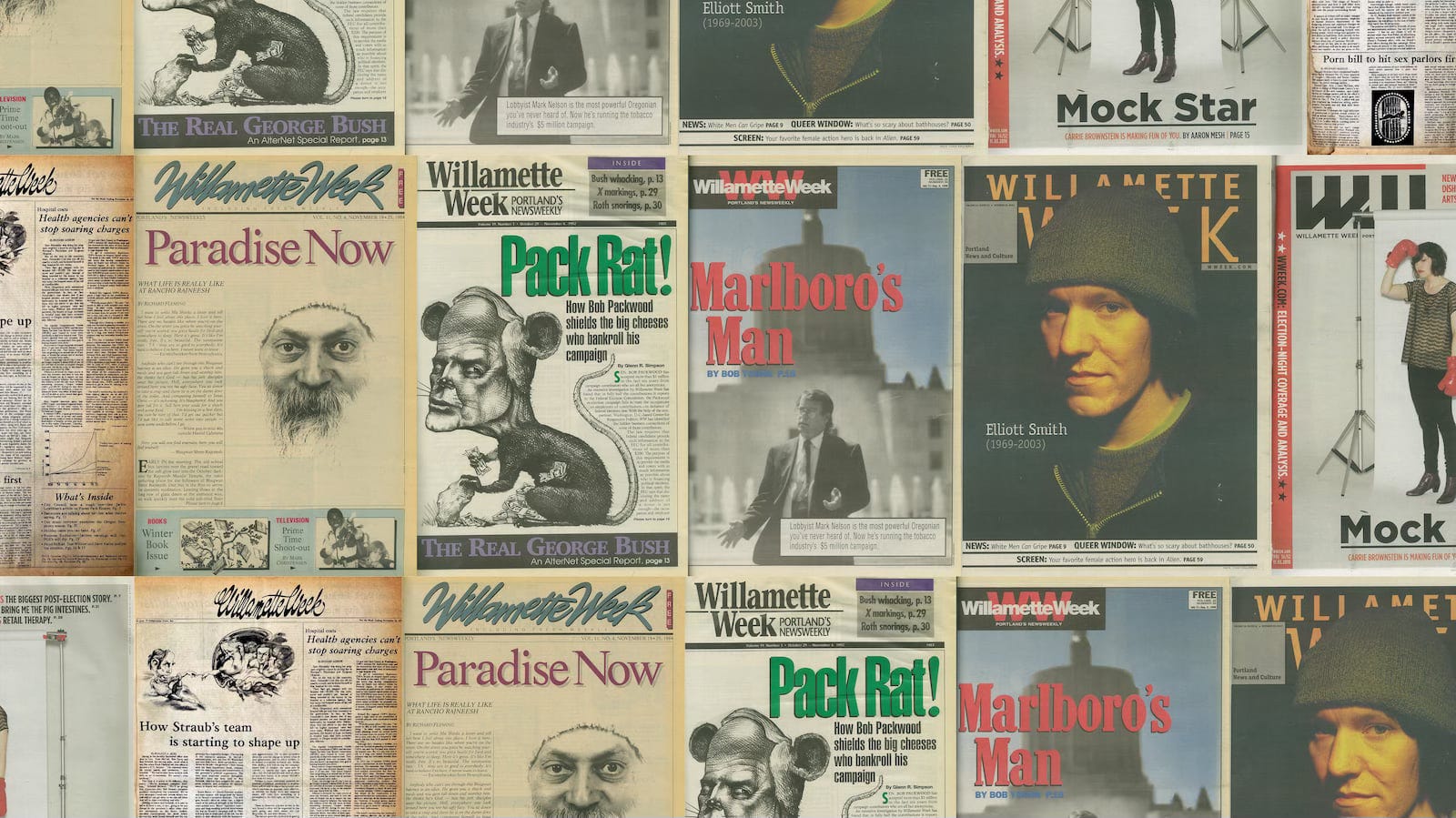
“A Brief History of Willamette Week’s Cover Logo From the People Who Helped Shape It: Cursive, serif and leaning into the future” (I do like the first!)
Susan Orlean, in her recent memoir Joyride (out in paperback in October), wrote that the stories she covered as an absolute beginner at Portland, Oregon’s Willamette Weekly “just dawned on me. They were everywhere I looked. Portland felt so ripe. I was always being surprised by something I came across, so I took note of the surprise, and it would roll around in my head until it started to nag gently at me, demanding to be explored and then written. Often I drove around and looked, and I almost always found something that warranted further looking.” Willamette Weekly was a so-called “alt weekly,” a member of the tribe of papers that flourished between the seventies and the teens, usually passed out for free at train stations, on street corners, in coffee shops, underwritten by local and classified advertising. Journalist Jeff Sharlet, in an essay last summer about his stint in his twenties at the San Diego Reader, wrote that alt weeklies “helped shape a way of thinking about cities: messy, thrilling, sad, funny, queer, glorious, pompous, comically crooked and endlessly fascinating.” Alt weeklies thrived in areas dense with small businesses and readers looking for each other. Early publisher Rob McCamant said of the Chicago Reader, founded in 1971 and inspiration for the San Diego Reader and a host of others, “I think what happened in a number of cities at the same time was that the intellectual and cultural and social life developed in the center city that caused the revitalization of the cities, which were otherwise being sucked dry by the suburbs.” “It’s a picture of how this generation realized that cities were cool places to live,” he wrote. “In Chicago we were people of a certain age who wanted to come downtown, to come into the city, to go to clubs and bars, restaurants and tiny art galleries, and things like that. We were the mechanism by which they discovered that these things existed.”
Although alt weeklies were mostly distributed in public places, maintaining 25 percent editorial content (as opposed to advertising) qualified them as a “periodical” entitled to reduced postage under USPS laws designed to support the press (hence our name, “Book Post,” an old nickname for discounted Media Mail). This created what now seems to writers an unimaginable situation: editors hungry for material, willing to try out just about anyone, and happy to encourage them to go on at length. Journalist Achy Obejas said of the Chicago Reader, “You got published for one of two reasons: You either were the best thing that came in over the transom or the only thing that came in over the transom.” “I never had so much fun pulling a regular paycheck,” wrote journalist Tristram Korten of his stint at Miami New Times. Three former writers for the Cleveland Scene agreed, “It’s the best job. It’s insanely fun … the number of things you can do is limitless.” “I think that at least a couple of the principals really thought that they could get rich doing this,” former editor Michael Lenehan said of the early days of the Chicago Reader. “Or that they could make a lot of money. Not that they were that interested in the money. What they were mostly interested in was making a living while having fun. And the fun part was a big part of the equation.”
Read Ruth Franklin in Book Post on Susan Orlean
Editors relied on freelancers to come up with subjects, training their gestational abilities. As Kyle Swenson, now of The Washington Post and formerly of Cleveland’s Scene described it: “At alt weeklies, you’re just always having to fire story ideas all the time, especially if you have to come up with five-thousand-word feature ideas, and then small ideas … it’s like, we have to fill the fucking paper with something.” Fellow Scenester Sam Allard adds, “You’re cranking out material at an unbelievable rate, and, with all due respect to aggregators and stuff, it’s not stuff like people who are doing online ‘content,’ we can’t put that bullshit in the newspaper, so it’s got to be, you know, originally reported material on a weekly basis, it’s just nonstop writing and reporting.” Says Susan Orlean of the skills she took from alt-weekly writing, “story ideas are everything … ideas are what make you a writer.”
Mark Jacob, a former metro editor of the Chicago Tribune who wrote a long anniversary retrospective on the Chicago Reader that is the germ for a new book, explains that the Reader “relied primarily on freelancers to tell the paper what was interesting. And it didn’t have to be the traditional definition of news.” They were encouraged to “look in places that were not full of newspaper and TV reporters, to go to the places where they weren’t,” and to look for “small stories that would illustrate larger points.” The Reader famously won a national journalism prize for a twenty-thousand-word essay on beekeeping by Michael Lenehan.
“In all those years, when his peers were very busy professionally writing,” Dana Goodyear wrote in a New Yorker profile of one of the most revered writers to emerge from alt weeklies, LA Weekly’s Jonathan Gold, the first person to win a Pulitzer for food writing, “Jonathan was professionally wandering around not writing. By background, inclination, and practice, he has always been the one who knows the most stuff close to the ground.” Helen Rosner wrote, also in The New Yorker, “his uncommon grace as a critic came from a compulsion to look for beauty and truth in the overlooked and the marginalized.” Adrian Nicole LeBlanc, whose epic work of narrative nonfiction Random Family had its start in a piece commissioned by The Village Voice, grandfather of them all, when she was working a desk job at Seventeen, has said (also in The Village Voice), “I’m really interested in the richness and political necessity of understanding mundane life.” Steve Bogira told Mark Jacob that he appreciated that the Reader covered working class neighborhoods, like the one he grew up in, that were neglected by the dailies.
Read Adrian Nicole LeBlanc in Book Post
Over at the Voice, editor Dan Wolf, who founded the paper in 1955 with Norman Mailer and the royalties from his first novel The Naked and the Dead, essentially creating the genre (although the Voice sold at newsstands for five cents), avoided hiring journalism-school graduates. Tricia Romano’s 2024 oral history of the Voice, The Freaks Came Out to Write, is full of stories of pieces sent in over the transom and appearing the next week on the cover, or writers walking in the door and getting offered a job. Ed Fancher told Tricia Romano that Dan Wolf “wouldn’t hire anybody from journalism school. He wanted writers from English departments. He said journalism school spoils most of them.” Gustavo Arellano describes being invited to contribute to Orange County’s OC Weekly after writing a fake letter to the editor. Susan Orlean writes, “we believed, with pride, that we could write circles around the stodgy dailies.”
Read former Voice media columnist James Ledbetter in Book Post on The Freaks Came Out to Write
Alt-weekly denizens felt that journalists at the mainstream dailies patronized and scorned them, even as they looked to the alt weeklies for the city’s real stories and stole ideas without attribution. Salt Lake City Reader founder James Saltas tells of writers from competing local dailies writing for his paper under pseudonyms, to get a taste of the action. “Whenever [the other papers] mocked us,” Saltas laughed in an interview, “it was their own writers they were mocking.” On the whole though alt-weekly writers tended to be, as former Washington City Paper editor Jack Shafer described them, “outsiders who eschewed the aspiration track.” Jonathan Gold, whose first job at LA Weekly was as a proofreader (like, for instance, James Wolcott, who worked the circulation desk at the Voice), characterized his workplace as “the employer of last resort for the misfits and malcontents who make up the majority of any respectable rock & roll scene, a place where an excess of tattoos, a tendency toward Tourette’s-like outbursts, and an inability to rise before noon were not necessarily impediments to a semi-successful career.”
Bringing so many new writers from zero to sixty made for virtuosic editors. Ed Fancher says the Voice’s Dan Wolf “rarely used a red pencil on copy. Instead, he would sit down with the writer and say, ‘Well now, why didn’t you say this? And did you think about that?’ He would talk it through.” Keith Harris, formerly of Minneapolis’s City Pages, has said, “there was the in-person edit where you would go word by word by word … you’d have an editor say, okay, this is just wrong. This is grammatically wrong. We have to change this. And then, well, this, what you’re saying here is this. You could say that or you could say this, which is better. And then you’d say, well, no, I want to say this. And then you would work it out … it’s more democratic. It’s more cooperative. It’s less alienating. And it’s a form of mentorship that creates younger writers and editors who are able to do that in the future. It’s something that I think is a lost art.” Jonathan Gold wrote, “I learned how to write at LA Weekly, largely under the tutelage of Bob LaBrasca, whose preferred method of getting a writer to change an offending passage was to read it back to him in a sarcastic tone.”
Former Chicago Reader editor Martha Bayne describes the “editorial boot camp” that she entered when she was hired just to edit restaurant listings: her own editor worked through every one of her edits with her. The Chicago Reader had a five-layer editing process that “was a source of tremendous pride.” Her boss Alison True used to say that they worked with two competing principles: “no mistakes,” vs. “good enough for a free paper.” Mark Jacob writes that their scruffy printer tolerated a large debt in part because he was impressed by the lack of typos and respectful attention to layout. “Boot camp” is a phrase that recurs in recollections of the alt-weekly editorial experience. Cleveland Scene writers called their improvisational workplace a “lab,” with “freedom to test editorial limits.”
Susan Orlean wrote in Joyride that “I became a real writer at Willamette Week.” Her editor Ron Buel “believed we should aim for fairness and truthfulness rather than strict objectivity”: the limitations of an individual perspective are “part of the story, since they are part of the real human experience—the mess, the misinterpretation, the variation and imperfectible nature of perception … What matters in a piece of writing is to acknowledge the fingerprints the writer leaves on the story …”
Read Part II of “Alt Writing” here
Ann Kjellberg is the founding editor of Book Post. Read more of her Notebooks on books and the reading life here. Paying subscribers can find her weekly Editor’s Notes in their emails or the Substack chat.
Book Post is a by-subscription book review delivery service, bringing snack-sized book reviews by distinguished and engaging writers direct to paying subscribers’ in-boxes, as well as free posts like this one from time to time to our followers. We aspire to grow a shared reading life in a divided world. Become a paying subscriber to support our work and receive straight-to-you book posts. Some Book Post writers: Ian Frazier, Joy Williams, Jamaica Kincaid, Lawrence Jackson, John Banville, Marina Warner, Álvaro Enrigue, Mona Simpson, Nicholson Baker, Colin Thubron, John Guare, Michael Robbins, more.
WordsWorth Books in Little Rock, Arkansas, is Book Post’s Spring 2026 bookselling partner. We partner with independent booksellers to link to their books, support their work, and bring you news of local book life across the land. We send a free three-month subscription to any reader who spends more than $100 at our partner bookstore during our partnership. To claim your subscription send your receipt to info@bookpostusa.com.
Follow us: Instagram, Facebook, TikTok, Notes, Bluesky, Threads @bookpostusa


I have fond memories of San Jose's Metro. They made a heroic effort to critique the tech bros' lack of taste.
I was less enamored of San Diego's Reader. They had mostly amateur writers who didn't know anything about the arts, and whose prose was pedestrian.