
Notebook: Alt Writing III
Critics’ Uncertainty Principle: Is the character of culture altered by being observed?
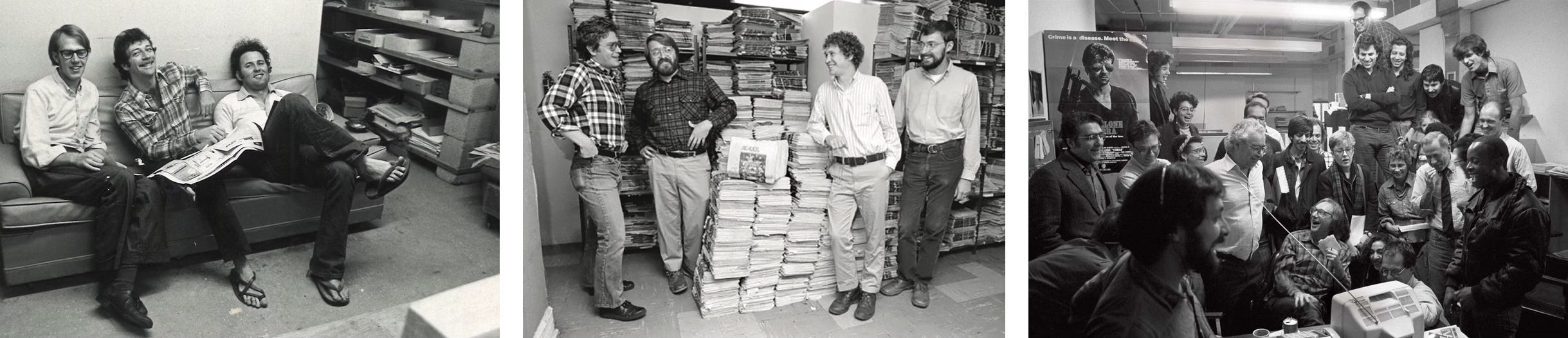
New Times founders Michael Lacey (center) and Jim Larkin (right) at the Phoenix New Times offices in 1972; Chicago Reader founders (from left) Tom Rehwaldt, Bob Roth, Tom Yoder, and Bob McCamant in 1979; cover image from The Freaks Came Out to Write, Village Voice staffers in 1986, by Catherine McGann

Read Parts I and II of this post here and here
Like the classified and local business ads that kept the lights on, the event listings that made alt weeklies required reading also informed their character. The editors and writers who compiled the listings were ferreting out shows and happenings all over town and discovering in the process culture that “has yet to explode,” as Chicago Reader editor Tracy Baim put it. “The woman who did the music listings,” Chicago Reader founder Tom Yoder recalled for Mark Jacob’s fifty-year retrospective of the paper, “part of her routine each week was to call this guy at the Jazz Record Mart and find out who was playing this weekend at these obscure south- and west-side bars. Because we wanted to be comprehensive.” Music critic Ann Powers has said she “remembers going to shows most nights, then working into the early morning at [San Francisco’s SF] Weekly’s old office on Bryant Street, putting together the week’s calendar listings.” In a passionate elegy for such music listings, composer Gabriel Kahane wrote last summer that they “weren’t just a boon for artists like me,” picking them out from the flock and bringing listeners to obscure places to hear their music, “they were also a teeth-cutting opportunity for cub journalists, one that demanded brutal concision.” “In its heyday,” he writes of the Village Voice, its newsroom
reverberated with the chaotic counterpoint of freaky choristers, all covering New York City with an obsessive commitment to hyperlocalism: Scenesters haunted hardcore shows at warehouses in Brooklyn; theater nerds ventured to East Village basements for experimental one-acts; dance lovers frequented Lower East Side nightclubs to cover bawdy performance art and contortionist spectacles. Here was a newspaper that, through dogged documentation of small and sometimes-fragile artistic microclimates, came to wield wide-reaching influence over national aesthetic trends.
LA food writer Jonathan Gold, who began as a “classical cellist with punk sensibilities,” wrote that music was “snuck in around the edges at the [LA] Weekly … as Wednesday-night rock picks, in rogue gig reviews, or as part of the listings written by a last-minute substitute, when the regular guy was off nursing a hangover.” Village Voice theater critic Jerry Tallmer covered the experimental plays that were just beginning to be performed in small bars and cafes, coining the phrase “off-off-Broadway.” The Voice oral history The Freaks Came Out to Write recounts how when the Voice began publishing in 1955 “there was no place to do plays if you were not commercial in some way.” What small theaters there were mounted classical plays not new playwrights. Being noticed by the Voice created an audience for new and experimental theater. The Chicago Reader kept ad rates low so “theaters had a place to advertise. And if there hadn’t been a publication where they could advertise, where people could find out about them in the listings, where their plays could be reviewed, I really think the theater scene would not have grown as fast and as rich and as various as it was.” My friends who are playwrights lament that coverage of new plays has virtually disappeared in New York, except for the looming, intermittent pronouncements of the Times. Julia Dixon Davis, on a KPBS show about the San Diego Weekly, spoke to the station’s student assistant about what alt weeklies used to do, and he sorrowed that his social media feed only shows him what he is already interested in and doesn’t help him find new things. As Gabriel Kahane observes, without intrepid critics and editors seeking out new work, established celebrities and their promotional machinery inevitably dominate audiences’ field of view. Joe Levy said of the Voice, they took “things seriously—small things, developing things, emerging things—that other places didn’t.”
Initially alt weeklies were scrappy, low-paid affairs, but by the nineties their winning formula of classified advertising, event listings, and eclectic journalism to while away the time at the laundromat or in a bus station was raking in millions. Apartment listings in particular were a gusher of cash. Like many New Yorkers of a certain age I remember waiting in Astor Place for the first issues of the Voice to come out to get the jump on all the other apartment hunters. In Chicago thieves would steal the (free) classified sections of the Reader from the printer to sell on the street for a dollar. Another rich source of revenue was “adult services” ads eschewed by conventional outlets. (Susan Orlean: “Yes, much of the profits probably came from the skanky sex-service ads in the back of the magazine, but that’s business.”) Revenue at the Chicago Reader, for example, went from $80,960 in 1975 to $22.6 million in 2002, its peak year. According to Jack Shafer, classifieds provided between 20 percent and 50 percent of alt weeklies’ earnings. Many thriving alt-weekly editors and writers turned down offers from the establishment press and both made an honest living and a mark on the culture from their alt-weekly desks, like the Chicago Reader’s Mike Miner: “Daily journalism … had grown stale to him. ‘You find yourself covering the same stories over and over. Every night there’s a fire, and every year there’s a Saint Patrick’s Day parade.’” I know one alt-weekly employee whose savings from their paper’s profit-sharing arrangement helped them make a down payment on a house.
Many factors contributed to the evaporation of these benevolent circumstances, not least the omni-amuser in our pockets. (Jack Shafer: “Even a human fossil must concede that the smartphone trumps the alt weekly as a boredom killer.”) Chain stores and then internet retail obliterated the local businesses that advertised in alt weeklies and the foot traffic that distributed them. Gustavo Arellano argues that the alt weeklies, which were beset by a wave of consolidations that interrupted their signature hands-on editing style, had only themselves to blame for failing to rise to the circumstances. But the arrival of Craigslist at the turn of the millennium was a decisive blow. “We couldn’t imagine that anybody would give away vast quantities of classified advertising like Craigslist did,” Chicago Reader founder Tom Rehwaldt says. Anil Dash, who had just arrived at the Voice from Silicon Valley to work on classifieds when Craigslist launched in New York, said, “Hey, what are we doing about Craigslist?,” and no one knew what he was talking about. “I was, like, ‘Oh my god, we’re screwed!’”
Trevor Aaronson , Sam Eifling, and Michael Mooney’s podcast Hold Fast recounts how Mike Lacey and Jim Larkin of the New Times chain of alt weeklies, which grew out of the Phoenix [Arizona] New Times, tried to create an alternative to Craigslist, called Backpage, that would funnel profits back to the alt weeklies, but it was brought down my Mike Lacey’s refusal to limit, as Craigslist had, ads for sex, which he fought as a First Amendment issue. Politicians who had been targeted by the New Times lined up to accuse Mike Lacey and Jim Larkin of “sex trafficking.”
A few alt weeklies carry on, though some have become fronts for “AI slop” or are perhaps quiescent. The Chicago Reader is experimenting with nonprofit models. SF Weekly’s emma silvers last year founded a Bay Area collective called Coyote: she argues that the different independent publishers have their own “lineages” and audiences and can work collegially in concert. The San Diego Reader’s editor Matthew Lickona is trying to make a go of it online. Aimee Leavitt reported last year in the Columbia Journalism Review that AAN Publishers (formerly the Association of Alternative Newsweeklies) has a membership of 120 papers, achieved in part by expanding to include “niche” publications as well as “general interest” papers. While I was working on this post I encountered enthusiastic readers of Vermont’s Seven Days and Seattle’s The Stranger (which is buoyed being home to sex columnist and podcaster Dan Savage). Some formerly “alternative” papers are now the only local paper standing. It does seem there is a real need for local event listings with an overlay of critical intelligence. It’s a bit surprising there is not yet a viable “app for that.”
Many alt weekly proponents note that the business model went away, but, as a group of former Minneapolis City Pages writers put it, demand did not. Gustavo Arellano writes that those alt weeklies that remain “still do important local work that dailies long ago forsook and that new media have no interest in.” What I am struck by, considering the fate of alt weeklies, is their proximity to what I see as an emergent yearning—post-pandemic, post-smartphone, as the chatbots loom—for inhabited and shared experience, an interesting convergence between the benefits of in-person gathering and the opportunity to write and read at length. The alt-weekly style is an antidote to, as Jeff Sharlet described it, “the compression of social media [that] has reduced narrative to instant opinion.”
Former Chicago Reader publisher Jane Levine recalls “the incredible physical presence that the paper had in the neighborhoods where it was distributed—those huge stacks of huge papers that would appear, and then disappear, in the entryways of record stores and bars and bookstores and student unions.” “There were like ten clubs that all let out at the same time, and everyone convened at Sparky’s,” remembers the musician Brontez Purnell. “And there would always be stacks of [Bay] Guardians there, so that’s what people would be looking at.” Susan Orlean got story ideas, and Chicago Reader editors hunted down classifieds, and Voice listings writers found new shows, by scrutinizing neighborhoods’ flyers and bulletin boards. KPBS’s student assistant says yearningly of a printed newspaper, “It’s tangible. You can hold it. You feel the paper. There’s a sensory, like, attachment to it … You can always look back at that as the starting point for when you discovered a new band.”
John Saltas, inspired by the Chicago Reader (“I’d never seen such a paper,” he thought when he encountered it as a young journalist in Chicago, “Salt Lake should have one of these”), created the Salt Lake City Weekly as a way for membership-only liquor “clubs,” the only place in Utah where you could commit public drinking, to advertise: the Weekly was literally about getting people to go out. Nate Chinen, who wrote the jazz listings at The New York Times from 2005 until 2016, told Gabriel Kahane that “the fundamental utility of a publication is bringing people out.” Jonathan Gold “often spoke of his hope that his writing would motivate Angelenos to step outside the comfort of their enclaves and get to know their neighbors.” Paul Farhi wrote in The Washington Post that the alt weeklies “offered what no national news sites now does—consideration of a common municipal space.” Music critic Ann Powers, who got her start at SF Weekly, put it succinctly, at a time when digital experience gives us a generalized everywhere, where information is directed towards us by its appeal to a disembodied numerical mass, “the weeklies facilitated actual human interaction.”
As alt weeklies search for nutrients and remind readers of the coalescences of circumstances that did so much, through them, to nourish American writing, they invite us to think about a new thing—a new thing that might meet a cluster of needs that the digital systems that have commandeered our cognitive lives neglect: the need to bring people together in real life, to help them discover new creative work, to foster informed awareness of the polis, to transmit the craft of writing and, with it, the purveyance of truth, and to get people to read.
Ann Kjellberg is the founding editor of Book Post. Read more of her Notebooks on books and the reading life here. Paying subscribers can find her weekly Editor’s Notes in their emails or the Substack chat.
Book Post is a by-subscription book review delivery service, bringing snack-sized book reviews by distinguished and engaging writers direct to paying subscribers’ in-boxes, as well as free posts like this one from time to time to our followers. We aspire to grow a shared reading life in a divided world. Become a paying subscriber to support our work and receive straight-to-you book posts. Some Book Post writers: Ian Frazier, Joy Williams, Jamaica Kincaid, Lawrence Jackson, John Banville, Marina Warner, Álvaro Enrigue, Mona Simpson, Nicholson Baker, Colin Thubron, John Guare, Michael Robbins, more.
WordsWorth Books in Little Rock, Arkansas, is Book Post’s Spring 2026 bookselling partner. We partner with independent booksellers to link to their books, support their work, and bring you news of local book life across the land. We send a free three-month subscription to any reader who spends more than $100 at our partner bookstore during our partnership. To claim your subscription send your receipt to info@bookpostusa.com.
Follow us: Instagram, Facebook, TikTok, Notes, Bluesky, Threads @bookpostusa
Brought back a lot of good memories . . .Thanks Ann.
A good--if sad--story. I even liked reading 'penny savers' and 'Yankee traders' for a sample of the local.